Aerial Robots for Interaction and Inspection: Understanding Redundancy for Future Capabilities
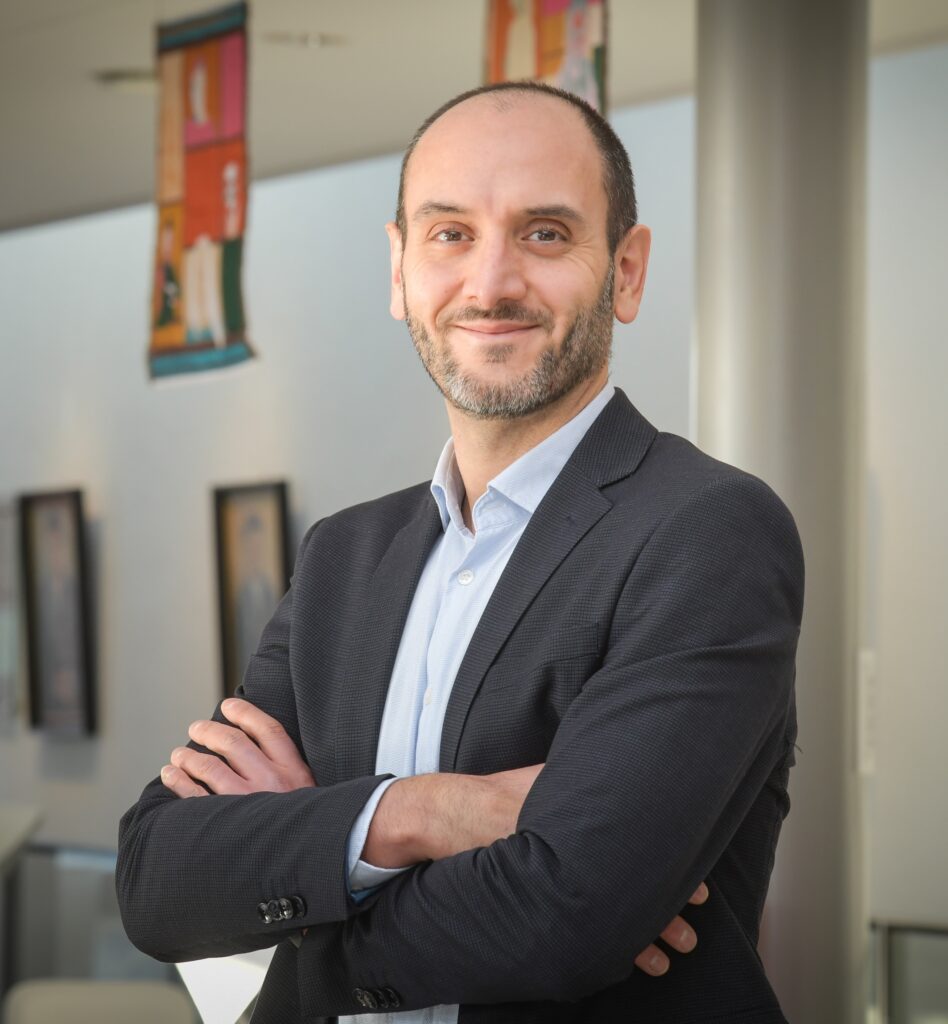
Antonio Franchi
IEEE Fellow
University of Twente (Netherlands)
Sapienza University of Rome (Italy)
Abstract
The vision of a flying robot physically interacting with the world dates back to the very origins of our field, notably the 1991 IARC competition. After a period of focusing on contact-free flight, the last fifteen years have seen this vision pursued with intensity through foundational collaborative research projects, culminating in the first wave of commercial systems for contact-based inspection and manipulation.
This progress brings our community to a critical juncture in 2026. It is time to ask the hard questions: Are we satisfied with the current state-of-the-art? What fundamental challenges must we overcome to achieve seamless human-robot collaboration in complex, unstructured aerial environments—systems robust enough to operate all year round and in all weather, and to genuinely increase the productivity and well-being of human workers?
This keynote aims to frame a vision for the coming decade, interpreting the lessons of the past to identify the essential research directions. Furthermore, we will delve into a fundamental robotics debate: Are aerial manipulators so different from their terrestrial counterparts? We will explore why the powerful, data-driven methods that have revolutionized other areas of robotics have not yet seamlessly translated to our domain.
Aerial robotics is progressing rapidly in applications such as inspection, physical interaction, and cooperative transportation, supported by advances in vehicle design, sensing, planning, and control.
These developments also motivate deeper questions about the internal structure of aerial robotic systems and about the role of redundancy in multirotor platforms.
In this plenary, I will present a perspective in which redundancy is viewed not only as additional actuation freedom, but also as a source of geometric and dynamical structure. This viewpoint enables the study of energy, responsiveness, and internal actuation patterns within a common framework, leading to recent results on aerodynamic promptness, topology-dependent tuning freedom, and passive aerodynamic interaction shaping. The talk will also highlight structural links between aerial robots and antagonistic compliant actuation systems, including muscle–tendon systems and bio-inspired variable-stiffness actuators.
The overall aim is to discuss how a deeper understanding of redundancy may support future aerial robot design and control, while remaining connected to the practical demands of real-world robotic applications.
Biography of the speaker
Antonio Franchi is a roboticist and IEEE Fellow whose research is dedicated to advancing the practical utility of aerial systems for society. A central theme of his work is addressing the challenge of enabling aerial robots to safely and intelligently interact with their environment. He explores these topics as a Full Professor at both the University of Twente (Netherlands) and Sapienza University of Rome (Italy).
His academic path includes previous research appointments at CNRS in France and the Max Planck Institute in Germany. His findings on decentralized control, multi-robot coordination, and aerial manipulation are detailed in over 200 peer-reviewed papers. This work, conducted alongside his students and collaborators, has received recognitions including a Best Paper Award at ICUAS 2024 and an IEEE RAS award for technical committee activities.
Active in the robotics community, he has served in editorial roles for the IEEE Transactions on Robotics and the International Journal of Robotics Research. To help connect researchers in his field, he co-founded the IEEE RAS Technical Committee on Multiple Robot Systems. Through his involvement in European projects like AUTOASSESS, AERIAL-CORE, and AEROARMS, he and his teams develop aerial robotic partners designed to support human workers, aiming to make complex, real-world tasks safer and more effective.