Resilient Multi-UAS in Complex Missions
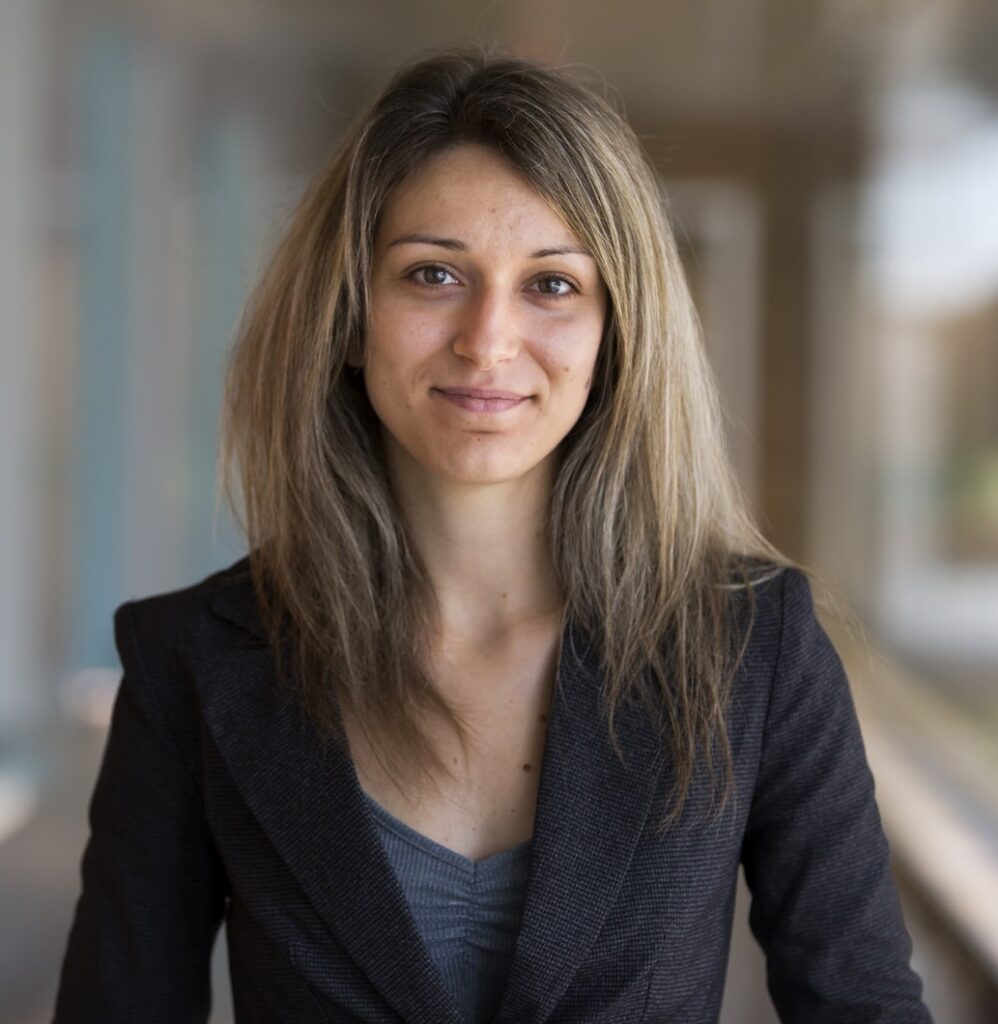
Dr. Dimitra Panagou
Department of Robotics, Department of Aerospace Engineering
University of Michigan
Abstract
Resilience of multi-agent cyber-physical systems in complex missions spans distributed learning, planning and control under constraints and uncertainty, and has been vivid across multiple fields including unmanned aerial systems (UAS). Multi-UAS systems in particular face significant challenges since uncertainty and constraints can be coupled across the “cyber” domain, e.g., the information shared via communication among robots or acquired via onboard sensing, and the “physical” domain, e.g., the plant/robot and environmental dynamics (e.g., wind), while the environment can be unknown or partially known, unstructured, or even unfriendly. Despite tremendous progress, there are still open problems, including how to achieve reliable mission planning in real time under constraints and uncertainty, and how to obtain system resilience that goes beyond worst-case robustness. In this talk, I will present an overview and highlights of our recent work on resilient multi-agent systems, with an emphasis on our autonomy methods for assuring safety, resilience and efficiency and their applications to multi-UAV flight and data gathering in complex environments.
Biography of the speaker
Dimitra Panagou received the Diploma and PhD degrees in Mechanical Engineering from the National Technical University of Athens, Greece, in 2006 and 2012, respectively. In September 2014 she joined the Department of Aerospace Engineering, University of Michigan as an Assistant Professor. Since July 2022 she is an Associate Professor with the newly established Department of Robotics, with a courtesy appointment with the Department of Aerospace Engineering, University of Michigan. Prior to joining the University of Michigan, she was a postdoctoral research associate with the Coordinated Science Laboratory, University of Illinois, Urbana-Champaign (2012-2014), a visiting research scholar with the GRASP Lab, University of Pennsylvania (June 2013, Fall 2010) and a visiting research scholar with the University of Delaware, Mechanical Engineering Department (Spring 2009). Her research program spans the areas of nonlinear systems and control; multi-agent systems, autonomy and control; and aerospace robotics. She is particularly interested in the development of provably-correct methods for the safe and secure (resilient) operation of autonomous systems in complex missions, with applications in robot/sensor networks and multi-vehicle systems (ground, marine, aerial, space) under uncertainty. She is a recipient of the NASA Early Career Faculty Award, the AFOSR Young Investigator Award, the NSF CAREER Award, the George J. Huebner, Jr. Research Excellence Award, and a Senior Member of the IEEE and the AIAA.